Selected Research5
Siyuan LiKe WanBoyong HouYujie DengZixuan Yuan
A continually updated benchmark for measuring the temporal boundaries of LLM financial knowledge and detecting parametric look-ahead bias.
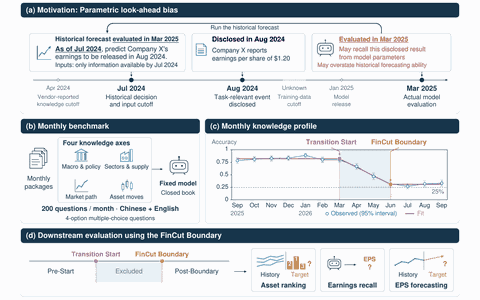
In financial backtesting and other point-in-time evaluations, LLMs may retain financial facts disclosed after the simulated decision date, introducing parametric look-ahead bias. However, the temporal coverage of such knowledge is difficult to measure, and vendor-reported knowledge cutoffs offer limited guidance for financial evaluations. We introduce FinCutBench, a continually updated benchmark comprising 9,000 Chinese and English four-option multiple-choice questions spanning January 2023 to September 2026, across Chinese and U.S. markets and four categories of financial information. For each model, we construct monthly knowledge profiles from closed-book accuracy on questions indexed by the estimated month when their underlying facts first became public. We characterize temporal declines using two markers: Transition Start, where the fitted accuracy begins to decline, and FinCut Boundary, where it reaches the later low level. We estimate these markers through statistical decline detection and segmented fitting, and assess localization stability under resampling. Among ten main models, nine exhibit statistically detectable declines. Using the measured dates to define downstream evaluation windows, we find a significant decline in U.S. asset-ranking performance relative to a matched baseline, while Chinese-market results are mixed across models, with no significant aggregate change. Earnings recall shows significant relative declines for some models. Meanwhile, EPS forecasting errors increase in later periods for both the evaluated models and the matched control, yielding no significant relative changes and suggesting a role for period-specific forecasting difficulty. These findings establish FinCutBench as an empirical framework for characterizing the temporal coverage of LLM financial knowledge and informing the interpretation of point-in-time evaluations.
arXiv preprint, 2026
Siyuan Li*Jian Chen*Rui YaoXuming HuPeilin ZhouWeihua QiuSimin ZhangChucheng DongZhiyao LiQipeng XieZixuan Yuan
The first large-scale Chinese dataset for financial regulatory compliance with an automated checking pipeline.
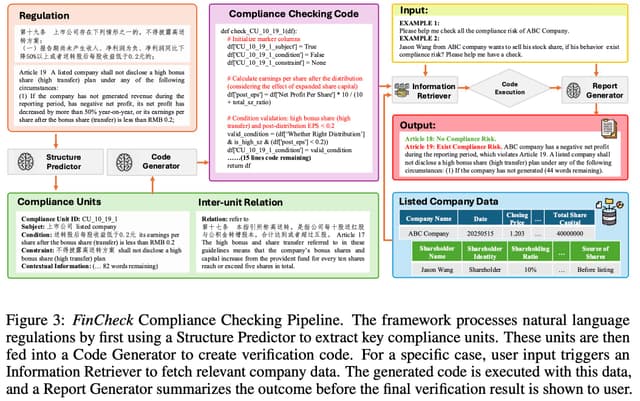
Regulatory compliance has become a cornerstone of corporate governance, ensuring adherence to systematic legal frameworks. At its core, financial regulations often comprise highly intricate provisions, layered logical structures, and numerous exceptions, which inevitably result in labor-intensive or comprehension challenges. To mitigate this, recent Regulatory Technology (RegTech) and Large Language Models (LLMs) have gained significant attention in automating the conversion of regulatory text into executable compliance logic. However, their performance remains suboptimal particularly when applied to Chinese-language financial regulations, due to three key limitations - (1) incomplete domain-specific knowledge representation, (2) insufficient hierarchical reasoning capabilities, and (3) failure to maintain temporal and logical coherence. To fill these gaps, we present Compliance-to-Code, the first large-scale Chinese dataset dedicated to financial regulatory compliance. Covering 1,159 annotated clauses from 361 regulations across ten categories, each clause is modularly structured with four logical elements-subject, condition, constraint, and contextual information-along with regulation relations. We provide deterministic Python code mappings, detailed code reasoning, and code explanations to facilitate automated auditing. To demonstrate utility, we present FinCheck - a pipeline for regulation structuring, code generation, and report generation.
KDD 2026 Dataset & Benchmark Track, Poster
Jian Chen*Siyuan Li*Chucheng WanZixuan Yuan
A span-grounded legal parsing framework for rules, exceptions, and scope relations.
This work targets the silent omission problem in statutory parsing by decomposing regulations into span-grounded deontic trees. The representation keeps rules, exceptions, and scope relations explicit so that complex legal control flow can be traced and audited more reliably.
KDD 2026 Dataset & Benchmark Track, Poster
KnowMT-Bench: Benchmarking Knowledge-Intensive Long-Form Question Answering in Multi-Turn Dialogues
2025Junhao Chen*Yu Huang*Siyuan Li*Rui YaoHanqian LiHanyu ZhangJungang LiJian ChenBowen WangXuming Hu
A benchmark for multi-turn long-form question answering in knowledge-intensive domains.
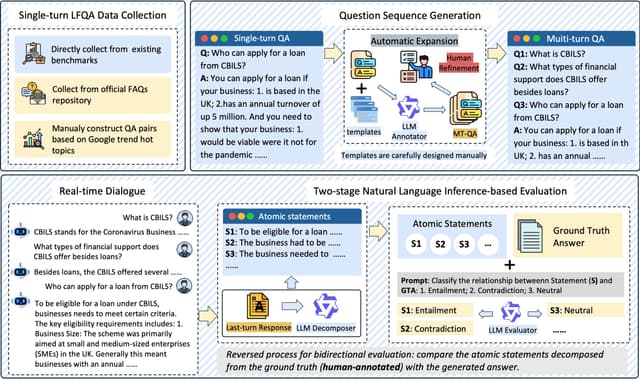
Multi-Turn Long-Form Question Answering (MT-LFQA) is a key application paradigm of Large Language Models (LLMs) in knowledge-intensive domains. However, existing benchmarks are limited to single-turn dialogue, while multi-turn dialogue benchmarks typically assess other orthogonal capabilities rather than knowledge-intensive factuality. To bridge this critical gap, we introduce KnowMT-Bench, the "first-ever" benchmark designed to systematically evaluate MT-LFQA for LLMs across knowledge-intensive fields, including medicine, finance, and law. To faithfully assess the model's real-world performance, KnowMT-Bench employs a dynamic evaluation setting where models generate their own multi-turn dialogue histories given logically progressive question sequences. The factual capability and information delivery efficiency of the "final-turn" answer are then evaluated using a human-validated automated pipeline. Our experiments reveal that multi-turn contexts degrade performance: factual capability declines due to the contextual noise from self-generated histories, while information efficiency drops as models become more verbose with increasing dialogue length. We then investigate mitigation strategies, demonstrating that retrieval-augmented generation (RAG) can effectively alleviate and even reverse this factual degradation. These findings underscore the importance of our benchmark in evaluating and enhancing the conversational factual capabilities of LLMs in real-world knowledge-intensive applications. Code is available at https://github.com/hardenyu21/KnowMT-Bench.
Findings of EMNLP 2026
Rui YaoQi ChaiJinhai YaoSiyuan LiJunhao ChenQi ZhangHao Wang
An uncertainty-aware framework for interpreting Federal Reserve communications with more reliable policy-stance predictions.
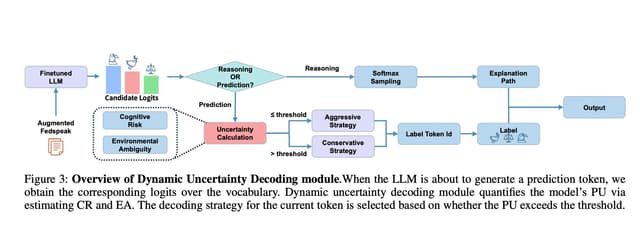
"Fedspeak", the stylized and often nuanced language used by the U.S. Federal Reserve, encodes implicit policy signals and strategic stances. The Federal Open Market Committee strategically employs Fedspeak as a communication tool to shape market expectations and influence both domestic and global economic conditions. As such, automatically parsing and interpreting Fedspeak presents a high-impact challenge, with significant implications for financial forecasting, algorithmic trading, and data-driven policy analysis. In this paper, we propose an LLM-based, uncertainty-aware framework for deciphering Fedspeak and classifying its underlying monetary policy stance. Technically, to enrich the semantic and contextual representation of Fedspeak texts, we incorporate domain-specific reasoning grounded in the monetary policy transmission mechanism. We further introduce a dynamic uncertainty decoding module to assess the confidence of model predictions, thereby enhancing both classification accuracy and model reliability. Experimental results demonstrate that our framework achieves state-of-the-art performance on the policy stance analysis task.
AAAI 2026, Oral