Selected publications4
Siyuan Li*Jian Chen*Rui YaoXuming HuPeilin ZhouWeihua QiuSimin ZhangChucheng DongZhiyao LiQipeng XieZixuan Yuan
The first large-scale Chinese dataset for financial regulatory compliance with an automated checking pipeline.
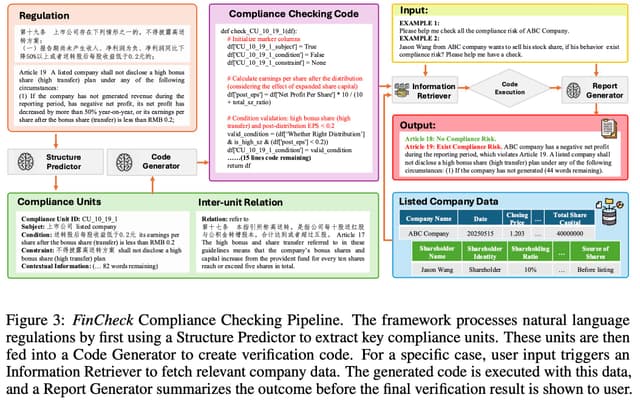
Regulatory compliance has become a cornerstone of corporate governance, ensuring adherence to systematic legal frameworks. At its core, financial regulations often comprise highly intricate provisions, layered logical structures, and numerous exceptions, which inevitably result in labor-intensive or comprehension challenges. To mitigate this, recent Regulatory Technology (RegTech) and Large Language Models (LLMs) have gained significant attention in automating the conversion of regulatory text into executable compliance logic. However, their performance remains suboptimal particularly when applied to Chinese-language financial regulations, due to three key limitations - (1) incomplete domain-specific knowledge representation, (2) insufficient hierarchical reasoning capabilities, and (3) failure to maintain temporal and logical coherence. To fill these gaps, we present Compliance-to-Code, the first large-scale Chinese dataset dedicated to financial regulatory compliance. Covering 1,159 annotated clauses from 361 regulations across ten categories, each clause is modularly structured with four logical elements-subject, condition, constraint, and contextual information-along with regulation relations. We provide deterministic Python code mappings, detailed code reasoning, and code explanations to facilitate automated auditing. To demonstrate utility, we present FinCheck - a pipeline for regulation structuring, code generation, and report generation.
KDD 2026 Dataset & Benchmark Track, Poster
Jian Chen*Siyuan Li*Chucheng WanZixuan Yuan
A span-grounded legal parsing framework for rules, exceptions, and scope relations.
This work targets the silent omission problem in statutory parsing by decomposing regulations into span-grounded deontic trees. The representation keeps rules, exceptions, and scope relations explicit so that complex legal control flow can be traced and audited more reliably.
KDD 2026 Dataset & Benchmark Track, Poster
KnowMT-Bench: Benchmarking Knowledge-Intensive Long-Form Question Answering in Multi-Turn Dialogues
2025Junhao Chen*Yu Huang*Siyuan Li*Rui YaoHanqian LiHanyu ZhangJungang LiJian ChenBowen WangXuming Hu
A benchmark for multi-turn long-form question answering in knowledge-intensive domains.
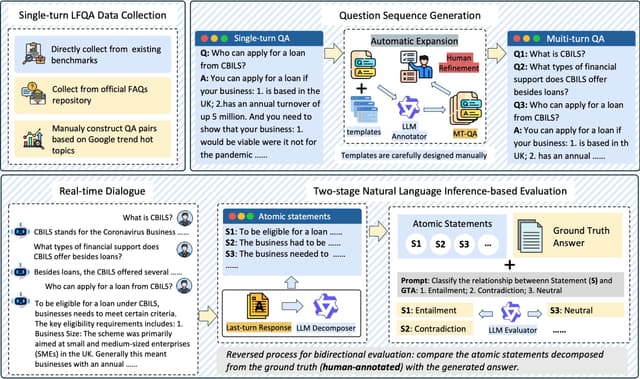
Multi-Turn Long-Form Question Answering (MT-LFQA) is a key application paradigm of Large Language Models (LLMs) in knowledge-intensive domains. However, existing benchmarks are limited to single-turn dialogue, while multi-turn dialogue benchmarks typically assess other orthogonal capabilities rather than knowledge-intensive factuality. To bridge this critical gap, we introduce KnowMT-Bench, the "first-ever" benchmark designed to systematically evaluate MT-LFQA for LLMs across knowledge-intensive fields, including medicine, finance, and law. To faithfully assess the model's real-world performance, KnowMT-Bench employs a dynamic evaluation setting where models generate their own multi-turn dialogue histories given logically progressive question sequences. The factual capability and information delivery efficiency of the "final-turn" answer are then evaluated using a human-validated automated pipeline. Our experiments reveal that multi-turn contexts degrade performance: factual capability declines due to the contextual noise from self-generated histories, while information efficiency drops as models become more verbose with increasing dialogue length. We then investigate mitigation strategies, demonstrating that retrieval-augmented generation (RAG) can effectively alleviate and even reverse this factual degradation. These findings underscore the importance of our benchmark in evaluating and enhancing the conversational factual capabilities of LLMs in real-world knowledge-intensive applications. Code is available at https://github.com/hardenyu21/KnowMT-Bench.
arXiv preprint
Rui YaoQi ChaiJinhai YaoSiyuan LiJunhao ChenQi ZhangHao Wang
An uncertainty-aware framework for interpreting Federal Reserve communications with more reliable policy-stance predictions.
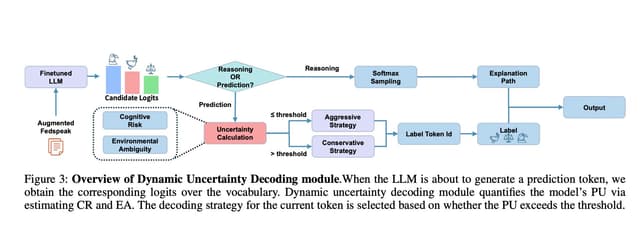
"Fedspeak", the stylized and often nuanced language used by the U.S. Federal Reserve, encodes implicit policy signals and strategic stances. The Federal Open Market Committee strategically employs Fedspeak as a communication tool to shape market expectations and influence both domestic and global economic conditions. As such, automatically parsing and interpreting Fedspeak presents a high-impact challenge, with significant implications for financial forecasting, algorithmic trading, and data-driven policy analysis. In this paper, we propose an LLM-based, uncertainty-aware framework for deciphering Fedspeak and classifying its underlying monetary policy stance. Technically, to enrich the semantic and contextual representation of Fedspeak texts, we incorporate domain-specific reasoning grounded in the monetary policy transmission mechanism. We further introduce a dynamic uncertainty decoding module to assess the confidence of model predictions, thereby enhancing both classification accuracy and model reliability. Experimental results demonstrate that our framework achieves state-of-the-art performance on the policy stance analysis task.
AAAI 2026, Oral